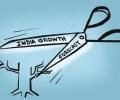
India's economy is projected to slow to 6.5 per cent in the fiscal year starting April but will remain the fastest growing major economy in the world as it fared better in dealing with the extraordinary set of challenges the globe has faced, the Economic Survey 2022-23 said on Tuesday. India's gross domestic product (GDP) growth of 6.5 per cent in 2023-24 compares with an estimated 7 per cent expansion in current fiscal year (April 2022 to March 2023) and 8.7 per cent in the previous year. Like the rest of the world, India too faced an extraordinary set of challenges in tightening financial conditions and supply chain disruptions from a prolonged war in Europe but "withstood them better than most economies", the annual document detailing the state of the economy said.

Samvat 2070 was a great year for top Indian conglomerates in the stock markets.

The Indian markets achieved another milestone on Friday. The Sensex conquered the 19,000-mark. The Sensex exhibited high volatility in early trades. After opening with a positive gap of 53 points at 18,824, the index tumbled into red to a low of 18,630. The index rebounded sharply and rallied to a high of 19,047 -- up 417 points from the day's low.

The sentiment around Indian equities remains positive and unchanged.

'Retail investors have been selling since the Budget and Foreign Portfolio Investors started selling.' 'Thus far, domestic institutions have picked up the slack, buying enough to keep the major indices from falling off a cliff.' 'However, there has been carnage in smaller stocks and the financial sector has been hit much harder than the major market indices,' points out Devangshu Datta.

Bank shares were the top losers after sharp gains last week.

Markets across the globe gained after China Securities Regulator removed its four-day-old circuit-breaker system.

India's services sector activity witnessed a sharp upturn in August on the back of stronger gains in new business, ongoing improvements in demand conditions and job creation, a monthly survey said on Monday. The seasonally adjusted S&P Global India Services PMI Business Activity Index rose from July's four-month low of 55.5 to 57.2 in August, amid a quicker upturn in business activity and the sharpest rise in employment for over 14 years. For the thirteenth straight month, the services sector witnessed an expansion in output.

'At this point, it does not appear to be a Lehman Brothers kind of crisis, which had a domino effect on the financial system.'

For 2021-22, it projected the economy to clock a growth of 10.6 per cent.

Sensex hit a record high of 27,225.85 and Nifty hit a record high of 8,141.90 in the intra-day trades today.
Hero MotoCorp was the top gainer in the Sensex pack, spurting 4.46 per cent. IndusInd Bank, Tata Motors, Vedanta, SBI, M&M, Sun Pharma, Tata Steel, HDFC and HDFC Bank too rose up to 3.63 per cent.

HCL Tech was the top gainer in the Sensex pack, rising over 4 per cent, followed by HDFC Bank, Infosys, NTPC, Nestle India, TCS and HUL. NSE Nifty surged 337.80 points to 14,845.10.

Hiring activity witnessed a 6 per cent year-on-year growth in March this year, supported by a rebound in economic activities and led by sectors such as banking and telecom, according to a report. However, there was a marginal dip of 2.4 per cent in hiring activity as compared to February, owing to the appraisal season, according to the Monster Employment Index (MEI). "Two years into the pandemic, it is heartening to see that the Indian economy has overcome setbacks and challenges with hiring momentum exceeding pre-COVID levels by 6 per cent this year compared to 2020," Monster.com, a Quess company, CEO Sekhar Garisa noted.
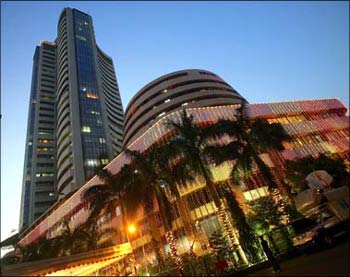
It will be difficult for the Indian equity to outperform overall growth to the extent bullish observers expect.

The broader markets are, however, outperforming the larger peer.
Markets will remain closed today on account of voting for the general elections in Mumbai constituencies.

Investor sentiments remained upbeat tracking global developments as the US, China geared up for trade talks due this week.

Given the prevailing uncertainties, investors must maintain a 10-15 per cent allocation to gold in 2023.

The focus will definitely shift towards more meaningful trips than the kind of micro trips we were into before, says Varun Arora.

Tata Steel, SBI, Infosys and L&T were among the top gainers for the day.

In Q1, India's GDP shrank by a staggering 24 per cent year-on-year amid the imposition of one of the most stringent global nationwide lockdowns.

Metal shares were the top gainers with Hindalco up over 5%.
This marks a turnaround after rupee's 158-paise plunge in the last three sessions.

Sensex, Nifty slightly upbeat, midcaps to rule markets this week.

Ends the August F&O series on a high tracking gains in RIL, HDFC and ITC.

The 30-share Sensex ended down 32 points at 28,851 and the 50-share Nifty closed 12 points lower at 8,712.

On the Sensex chart, NTPC, SBI, UltraTech Cement, ICICI Bank, Tata Steel, Bajaj Finserv and Bjaja Finance were among the major laggards, shedding as much as 1.63 per cent.

In New York market, the dollar continued to weaken against its rivals yesterday on a day devoid of major data releases out of Europe and the US.
Market ended lower for the third straight session led by IT stocks amid downgrade by Citigroup.

The 30-share Sensex ended up 204 points at 27,215 and the 50-share Nifty ended up 59 points at 8,238.
Markets recovered in late trades, amid firm European cues, led by rebound in financials and gains in IT shares.

'Money that came into mutual funds near the previous peaks -- the second half of 2017 and 2018 -- has in most cases experienced unflattering returns.' 'A large proportion of redemptions could be such inflows exiting when the market recovered sharply from July 2020 onwards.'

If there was one event that made the month of August stand out, it was a strengthening of the dollar index to levels last seen only 20 years ago, as the Federal Reserve dispelled all doubts about its intention to continue raising interest rates. Predictably, most currencies suffered against the US unit, with the bulk of the losers belonging to the emerging markets pack. Amid the volatility, the rupee, however, has displayed significant resilience and fared much better than most of its peer currencies.

Investors booked profits at higher levels with oil shares leading the decline

India's economy is estimated to contract by 9.6 per cent in the fiscal year 2020-21, reflecting a sharp drop in household spending and private investment, and the growth is expected to recover to 5.4 per cent in 2021, the World Bank said on Tuesday. In its Global Economic Prospects report, the World Bank said that the informal sector, which accounts for four-fifths of employment, has been subject to severe income losses during the COVID-19 pandemic.
PowerGrid was the top laggard in the Sensex pack, shedding over 2 per cent, followed by HCL Tech, ONGC, M&M, Axis Bank, TCS, Reliance Industries and Infosys. On the other hand, Asian Paints, Titan, Tata Steel, Bajaj Finance and Bajaj Auto were among the gainers.

Investors will remain cautious ahead of F&O expiry.

Bolstered by bullish investor sentiments, India witnessed companies mopping up a whopping $9.7 billion through initial share sales in the first nine months of 2021, the highest amount for the nine-month period in two decades, says a report. As many as 72 initial public offerings (IPOs) hit the stock market during the January-September period this year in India and strong sentiments were visible in the global markets as well, according to leading consultancy EY. EY, in its latest report, said the global IPO market continued to boom through Q3 2021 resulting in the most active third quarter by deal numbers and proceeds in the last 20 years.

When compared to the domestic sales of April 2019, the growth is around 37 per cent. However, compared to the previous month (March), the growth is 18.4 per cent.
